Small Room Acoustics
(Sound Theory)
Last updated on 4/13/07
(hints section edited)
The most commonly overlooked aspects of a recording studio is the acoustics. Without good acoustics it is almost impossible to get a good recording. Of course the most important factor is the source of the sound, meaning the musicians and their instruments. But of course the next thing between the source and the pickup device (i.e. the microphones), is of course the room itself. If you have a bad sounding room, it will destroy the sound of the guitarist's great $1,800 amp no matter how good your microphone is. A bad room will make a $5,000 drum set sound played by the world's greatest percussionist sound like an amateur playing on a $200 S-mart set. If you need proof, listen to Metallica's "Saint Anger" album. And that was actually a fairly good room. However, in order to have a stellar sound, you must have a stellar room. Because after all, the sound must filter through the room to get to said microphones and there's no way to get rid of the room sound once it is there.
What exactly makes a good room though? Some aspects of acoustics are purely subjective and up to personal taste. Other aspects are seemingly universal. There are so many factors involved in the quality of a room it is almost impossible to describe in any detail. There are literally volumes of books covering the science and art behind acoustics. Never-the-less, some concepts are fairly simple to grasp. Hopefully, a vague idea behind the subject can be understood at least enough to allow one to chose their rooms and room treatments effectively enough to be usable for their intended purpose. At the very least, one can use the knowledge to chose somebody to handle those details on their behalf. Regardless, acoustics are one of the largest contributors to both live sound and recorded sound whether on the recording side or the playback side.
Reflections are probably the single most important aspect of acoustics. Reflections, of course, are sound waves
bouncing off of an object. Note
that the angle of reflection will always be the same as the angle of attack
just like light to a mirror. Since
no surface is perfect, however, there will always be some “blurring” of the
reflection. A reflections are the
cause of echoes natural cases but echoes can be simulated by other means. Reflections can cause a lot of harm for
many reasons but they can also be a good thing. Reflections can obscure the true source of a sound under
certain conditions and can harm intelligibility. From 10ms-40ms (20 optimally), though, reflections can
actually help one localize the true source of a sound. In fact, echoes within this range can
be up to 10dB louder than the original source and not obscure the source
sound. This is called the Haas
effect and many studios actually have secular reflectors called “Haas kickers”
in place to deliberately cause this effect. The Haas effect is best used in moderation though and is
most effective when at least 10dB BELOW the direct sound in volume. Short reflections, even within the
range for Haas effect can cause other problems. On another note, a parabolic dish can be mated with certain
kinds of microphones to focus the mic’s pickup pattern to a pinpoint over long
distances. The dish reflects a
wide area of sound into a small area for the sake of intensifying it just as
satellite dishes focus radio waves from long distances into an antenna. These are commonly used in sporting
events where one may want to focus on a certain player or a certain sound
source. The Regardless,
reflections are a part of everyday life and help us comprehend our location,
the distance of objects, the source direction of objects and so forth. But as previously stated, they also
cause a lot of problems particularly where intelligibility is in question. Longer echoes are generally a lot less
offensive than shorter echoes.
Extremely short echoes (less than 20ms) cause phase cancellations, or
more specifically stated, 2 or more similar sounds passing the same point at
slightly different times interfere with each other. Some sounds get reinforced while others get cancelled. The effect is called “comb filtering”
and is almost always undesirable as it obscures detail and harms
intelligibility. A flanger effect,
relies on a continuously varied short delay to cause phase cancellation. In this case it’s a desired special
effect. Generally speaking though,
delays of less than 5ms are particularly harmful and if they can’t be avoided,
one should at least take care to minimize the effect by careful placement of
objects in relation to boundaries and microphones.
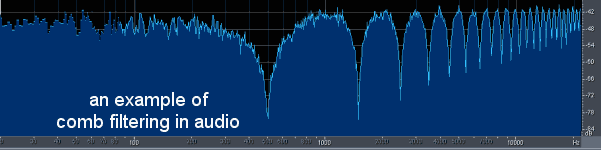
Having several open microphones in a given environment can have the same effect as a reflection. For instance, if more than one instrument is being recorded at a time, then there will likely be several mics in the same general area. Multiple in-use microphones can produce results similar to reflections except there is no time for the sound to return to a source so a mic 5’ behind another will add about a 5ms delay whereas a wall 5’ behind a microphone will cause a 10ms delay as it takes time for the sound to bounce back to the first microphone. Based on the rule of thumb for sound traveling at 1,130’ per second, the distance between microphones in relation to the sound source alone will determine the delay between signals. So if a microphone is 1’ away from a guitar cabinet and there is another microphone 5’ away for another guitar cabinet, then there will be a delay of approximately 4ms between guitar mics. Sometimes it’s impossible to avoid delayed signals between microphones but the effect CAN be reduce by carefully regulating the distance between sound sources and microphones. It may be necessary to get a mic closer to its intended sound source to either allow the volume of that source to be reduced and thus reduce bleed into another mic OR so the intended source is louder in the microphone thus reducing leakage from another source. One can also use baffles to reduce the direct sound from one source accidentally getting received by an unintended receptor. In case of the use of baffles, it is important to angle the baffles to avoid reflecting a sound source directly into a nearby microphone as this can be equally damaging or worse than bleed into another microphone. On a side note, a given person can only be in one part of a room at a time. By having many microphones in different parts of a room or worse yet, in different rooms, it becomes subconsciously disturbing to a listener who hears a recording made in this fashion as they are hearing ambience of different environments at the same time which does not occur in nature. It is for this reason that the most natural sounding recordings tend to be recording using a single stereo pair of microphones in a fixed position of a given room. Also this is why using multiple artificial reverberators is generally not a good idea unless they are blended together in some fashion.
The first and most important aspect of acoustics is the size and shape of the room itself. Shape is as important as size but in some ways it is more important than others. When a room has parallel walls (like almost all rooms), sound gets caught bouncing back and forth between all the parallels walls. Some sound waves are cancelled out by their own reflection of the walls while others are reinforced. This interference changes according to the position of the sound source and the listener (microphones included). That stated, having a room where all would-be 90 degree angles are offset by 10-20 degrees will drastically reduce the redundant reflections between walls and thereby almost eliminating "standing waves" or waves that are reinforced to the point they create a "boomy" sound. It is not recommended to have angles of less than 70 degrees because low frequencies like to congregate in corners. The tighter the corner, the more bass tends to build up in them. There is an entire industry built around sound absorption just for corners but this will be covered at a later time. To further explain standing waves, it is said that a sound traveling from the speaker past the listener and bouncing off the back wall will come back past the listener increasing the volume at that particular frequency by 3 Decibels (AKA dB). Decibels are a parabolic function of sound energy where 3dB equals a factor of 2. That is, a sound increased 3dB in sound is doubled in power. This is of course an ideal which is physically impossible because after all no reflection of energy is 100% efficient but the effect can be drastic enough that rounding to 3dB is acceptable. What most people fail to realize is that the standing wave will also reflect off of the front wall and back to the listener causing the overall sound to be further reinforced. This back and forth motion will reach a point of diminishing return of course but the standing wave itself can still be over 9dB louder than non-standing waves in extreme cases. These standing waves are a function of the room's dimensions measured against the speed of sound. Since the frequency of the standing wave has a direct correlation to the distance the sound travels within the room, it is commonly called a "room mode". One can determine room modes by dividing the speed of sound by the room dimension in question. This will show which frequencies in that environment will be standing waves. If the speed of sound is 1130 feet per second and your room is 30 feet long, the equation will be 1130/30=37.667. So 37.667Hz will be the mode of that room. Remember that multiples of all frequencies are also modes of a given room. Therefore, 37.667 is only the fundamental room mode and room modes occur at this number times 2, times 3, times four and so on indefinitely.
Believe it or not but the previously mentioned "spikes" in frequency response are the less offensive of room mode problems. In fact, while the effects of positive reinforcement within given wavelengths can severely increase the amplitude or volume of that sound, negative reinforcement can cancel out certain wavelengths altogether. This happens because when a sound wave is traveling, it consists of "crests" and "troughs" just like waves in water. When such waves bounce of walls or other object in a room, the waves will cross back over themselves. In some instances, a trough may cross a crest. Negative energy cancels out the positive so-to-speak. Now the positive vs. negative reinforcement is dependant on the position of the sound source in the room and the listening position. A listener may sit in one position of the room and hear say, 120Hz 3dB louder than the real source and if the listener moves over a few feet, there won't be any sound at 120Hz at all. This is probably the largest source of mixing problems in home studios and even many professional studios. If the mixing engineer cannot properly perceive the information coming out of the monitors, then they will make poor adjustments. It will also make a large difference in capturing original audio because of the room's interaction between a sound source and the microphone(s).
This is only looking at one room dimension. Standing waves can occur between any of the three dimensions of a given rectangular room. It is quite common for studio control rooms to be bilaterally symmetrical pentagons, hexagons or octagons where two or more walls are significantly longer than the others. The front wall which usually contains the studio window is the smallest and angled slightly downward from the perspective of the listening position. The ceilings are quite commonly angled as well to prevent standing waves between the floor and ceiling. Generally speaking, the front wall containing the window will be the lowest point for the ceiling and it gently slopes upward toward the back walls. Rectangular studios are acceptable under the pretense that the ratio of length to width to height are appropriate and that it is large enough to allow standing waves to diffuse naturally over a short enough period of time. If there are redundant dimensions or evenly divisible room dimension ratios, this problem can be compounded.
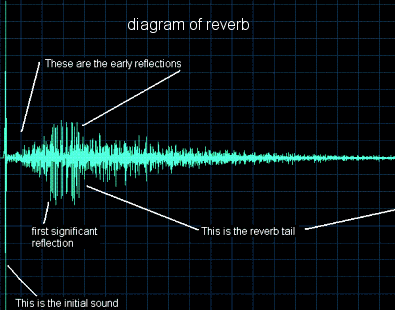 Reverberation (reverb for short) is defined as multiple random echoes which
are so dense, individual echoes cannot be distinguished. Under that
definition, a small room such as one found in a recording studio cannot
possibly contain a reverberant field because small room echoes never become
completely diffused enough so that they are indistinguishable. However,
this is a flaw in the definition of the term "reverb" because as the
size and shape of the room change, so does the diffusion of echoes within that
room. There is therefore, no definite way to differentiate between flutter echoes, that is, echoes which occur at
rapid predictable intervals, and true reverb as
this line is very fine from the beginning. Flutter becomes fully diffused
eventually due to anomalies in the surfaces of objects and the nature of the
way sound travels, it's just a matter of when. It may take a 90dB drop in
volume before that flutter echo environment becomes diffused. That would
without a doubt NOT be reverberant though. But since a reverberant field
is timed by how long it takes the sound to decay 60dB of its original volume,
what if the flutter echoes become diffused after the echoes decay to 59dB lower
than the initial volume? Does it then qualify as reverb?
Never-the-less, flutter echoes are universally undesirable and reverb is almost
universally desirable. Go into a normal room in a house such as a living
room or bedroom and clap your hands crisply once. Most likely you will
hear your clap sustained as a fluttering or "robotic" sound in such a
room. That is a flutter echo. Now repeat the same process in a
gymnasium or a concert hall and you will hear the sound decay in a smooth
way. This is reverb. Hear the difference between a small room with
a flutter problem verses a small room with a
well diffused reverberant field. In the posted links
above, one can clearly hear that one sample is well diffused and would consider
it reverb and the other simply flutter. Both samples were taken of the same
room treated differently. However, traditional definitions will deny that
either of them can be called reverb simply because they were made in a small
room.
Reverberation (reverb for short) is defined as multiple random echoes which
are so dense, individual echoes cannot be distinguished. Under that
definition, a small room such as one found in a recording studio cannot
possibly contain a reverberant field because small room echoes never become
completely diffused enough so that they are indistinguishable. However,
this is a flaw in the definition of the term "reverb" because as the
size and shape of the room change, so does the diffusion of echoes within that
room. There is therefore, no definite way to differentiate between flutter echoes, that is, echoes which occur at
rapid predictable intervals, and true reverb as
this line is very fine from the beginning. Flutter becomes fully diffused
eventually due to anomalies in the surfaces of objects and the nature of the
way sound travels, it's just a matter of when. It may take a 90dB drop in
volume before that flutter echo environment becomes diffused. That would
without a doubt NOT be reverberant though. But since a reverberant field
is timed by how long it takes the sound to decay 60dB of its original volume,
what if the flutter echoes become diffused after the echoes decay to 59dB lower
than the initial volume? Does it then qualify as reverb?
Never-the-less, flutter echoes are universally undesirable and reverb is almost
universally desirable. Go into a normal room in a house such as a living
room or bedroom and clap your hands crisply once. Most likely you will
hear your clap sustained as a fluttering or "robotic" sound in such a
room. That is a flutter echo. Now repeat the same process in a
gymnasium or a concert hall and you will hear the sound decay in a smooth
way. This is reverb. Hear the difference between a small room with
a flutter problem verses a small room with a
well diffused reverberant field. In the posted links
above, one can clearly hear that one sample is well diffused and would consider
it reverb and the other simply flutter. Both samples were taken of the same
room treated differently. However, traditional definitions will deny that
either of them can be called reverb simply because they were made in a small
room.
Room size itself is a great contributor to overall sound quality. The reverb time for a room is a parabolic function of volume. So as the volume doubles, so does the reverb time. Small rooms by definition do not have a true reverberant field because the reflections never become completely dispersed by the time the echoes have sufficiently decayed. Larger rooms, on the other hand, tend to have a very long Rt60 (the time for the ambient field to drop by 60dB) so a sufficiently dispersed reverberant field is much more possible. Of course, small rooms can quite possibly have large room characteristics and large rooms can have small room characteristics. Now the actual Rt60 is based not only on volume but also the reflection coefficients of the walls (the ability to reflect sound) and the presence of other objects in the room with it. A large room can be treated with sound absorptive materials in such a way that only a few echoes can be heard before it decays completely or a small room can be of material and shape (such as a cement pentagon with a slanted ceiling) and sound scattering devices called "diffusers" so that it will have a true reverberant field before decaying completely. Since the development of reverb is a parabolic function of a given room's properties depending on not just size, but also shape and reflectivity. The conundrum becomes apparent because of the common statement that small rooms do not have reverb but large rooms do.
Room ratios play heavily into the overall quality of sound obtainable. It is imperative to avoid redundant and multiples of dimensions. It is logical to assume that a room 10' x 8' x 10' will sound far worse than a room that is say 12' x 10' x 8' because standing waves would otherwise be compounded. Not only that, but it is much less likely for a reverberant field to develop in a room with redundant ratios. A room with equivalent multiples such as 10 x 20 x 8 will also be a problem because 20 is evenly divisible by 10 and therefore will have the same problem with standing waves as a 10 x 10 x 8 room. Although it will not be quite as bad in the 10 x 20 room because the modes within the room are factors of 2 and therefore only half the standing waves bouncing back and forth between the 20' walls will match up with the standing waves bouncing between the 10' walls. One way to find out if your room has acceptable ratios is to measure the room in all its dimensions then try to divide each dimension by the others. So if you have a room that is 28' by 23' by 8', follow the process where 28/23=1.22, 28/8=3.5 and 23/8=2.88. The ratios of this room are 1 x 2.88 x 3.5. Since none of these ratios are close to being even factors, this room will be acceptable. Certain ratios of room sound better than others even though they all may be mathematically acceptable. The reason for this is due to the natural overtones of sound. A single note played on an instrument actually contains many tones at a time and even though the fundamental frequency of such a note may not create a standing wave, its overtones might. Not only that but a chord may contain several wavelengths which coincide with modes of two or more room dimensions. Therefore some more complicated theory is needed. Ancient Greeks found that rooms with the ratios of 1 x 1.62 x 2.62 sounded universally good. Though these ratios are not perfect in all cases, they are good in general. In the case of our 28 x 23 x 8 room, there are only two coincidental modes which is quite good. You can calculate redundant modes by plotting out all possible modes and then finding which ones coincide. There are, however, many online resources that will plot them for you. A good resource is the "Room Mode Calculator" at http://www.realtraps.com/modecalc.htm. This will only calculate axial room modes. That is, it will only calculate and chart modes between any one room dimension. There are also tangential and oblique mode which are modes between two and three dimensions respectively. These modes tend to be less intrusive than axial modes but are important never-the-less. Since there are no known resources for calculating all three mode types together and charting them visually, one must hand chart them. A good resource is http://www.marktaw.com/recording/Acoustics/RoomModeStandingWaveCalcu.htmlfor calculating all three types of modes.
All that having been stated, naturally bad sounding rooms can be treated or
"tuned" to give acceptable results using a combination of diffusers
and absorbers. Learning to properly set up these materials can take a
lifetime but a few simple principles can be followed to gain a basic understanding.
Absorbers, like one can  guess
are intended to absorb sound to reduce echoes within a room. Diffusers
scatter echoes rather than absorbing them so that instead of having a single
large echo off of a single surface, many small echoes are achieve which will
hopefully go in several directions. Of course all absorbers and diffusers
work on different principles and thus behave in different ways. Due to
the long wavelengths, low frequencies are particularly difficult to absorb or
diffuse and therefore typical absorptive materials are not generally effective
for low frequencies. Though common acoustic treatments such as Auralex or
Sonex are VERY good absorbers at high frequency but low frequencies tend to
just pass right through them and bounce off the treated boundary
unscathed. In order to effectively damp low frequencies, the
absorber/diffuser must be dense enough that it impedes the motion of the free
field sound and also must be at least 1/4th the depth of the desired
effected wavelength. Waves are measured in degrees where a full
wavelength is 360 degrees. All waves are at a complete standstill when
reaching a boundary because the wave compresses the air in front of a boundary,
the air then acts as a spring board sending the wave away from that
boundary. A wall will thus always be 0 degrees in relation to any waves
hitting it. The most absorption occurs between 45 degrees and 135 degrees
as 90 degrees is the peak of the waves energy (1/4 wavelength). There is
another peak (AKA trough) at 270 degrees also but this is less relevant to the
subject. So in order to absorb the longest wavelength of human hearing
sufficiently, the absorber must theoretically be at least 14 thick.
The formula is stated as 1130(feet per second)/20Hz= wavelength of 56.5
feet. 1/4th of 56.5 feet would then by 14.125. The
results in practical function are not totally true as one may suspect because
extremely low frequencies (below 30Hz) tend to simply pass through gypsum
covered walls and are thus less of a factor.
guess
are intended to absorb sound to reduce echoes within a room. Diffusers
scatter echoes rather than absorbing them so that instead of having a single
large echo off of a single surface, many small echoes are achieve which will
hopefully go in several directions. Of course all absorbers and diffusers
work on different principles and thus behave in different ways. Due to
the long wavelengths, low frequencies are particularly difficult to absorb or
diffuse and therefore typical absorptive materials are not generally effective
for low frequencies. Though common acoustic treatments such as Auralex or
Sonex are VERY good absorbers at high frequency but low frequencies tend to
just pass right through them and bounce off the treated boundary
unscathed. In order to effectively damp low frequencies, the
absorber/diffuser must be dense enough that it impedes the motion of the free
field sound and also must be at least 1/4th the depth of the desired
effected wavelength. Waves are measured in degrees where a full
wavelength is 360 degrees. All waves are at a complete standstill when
reaching a boundary because the wave compresses the air in front of a boundary,
the air then acts as a spring board sending the wave away from that
boundary. A wall will thus always be 0 degrees in relation to any waves
hitting it. The most absorption occurs between 45 degrees and 135 degrees
as 90 degrees is the peak of the waves energy (1/4 wavelength). There is
another peak (AKA trough) at 270 degrees also but this is less relevant to the
subject. So in order to absorb the longest wavelength of human hearing
sufficiently, the absorber must theoretically be at least 14 thick.
The formula is stated as 1130(feet per second)/20Hz= wavelength of 56.5
feet. 1/4th of 56.5 feet would then by 14.125. The
results in practical function are not totally true as one may suspect because
extremely low frequencies (below 30Hz) tend to simply pass through gypsum
covered walls and are thus less of a factor.
Also, a sufficiently dense object placed away from the wall can act as an
absorber for specific wavelengths. This is called a diaphragmatic
Absorber. The idea is to have a semi flexible material spaced from a wall
so that the material moves with the initial sound. The reflected sound
from the wall which is now traveling the opposite direction of the direct sound
is met by the diaphragm still moving primarily in coincidence with the direct
sound and is thus severely reduced in power. An absorber for a specific
frequency is as follows 170 divided by the square root of Md. So M is the
density in pounds per square foot of the material used and d is the depth of
air space in inches between the material and the wall. So if you have a
piece of plywood that weighs lb per square foot and space it 3" from the
 nearest
wall, the absorption frequency will be 139Hz. The absorption only reduces
the amplitude (power at a given point) of the wave but it does have the advantage
of making room modes broader and less extreme. Taking this into a step
further lets us use this principle for broadband absorption. If one were
to use a porous material that is both dense and flexible, much broader ranges
of wavelengths can be absorbed. A very common material and one of the
best, is semi-rigid fiberglass. Typical acoustic foam 2" thick has a
density of 2lbs per cubic foot and is made to be applied directly to a
wall. Fiberglass products such as Owens-Corning
703 is closer to 5lbs per cubic foot, is fairly solid and is sold in large
sheets making it ideal for mounting on stands, suspended from the ceiling or
using small spacers to stand it away from walls. This is a great compromise
because getting the material away from the wall allows the material to be
closer to the free-field motion of waves in a given room making it far more
effective at absorbing low frequencies. Since it's a porous material,
the diaphragmatic absorption equation is "fudged" by
2" (or whatever the thickness of the material is) so that everything
between the front surface and back surface of the material factors into the
equation. Also, due to the porous and dense nature, high frequencies are
absorbed very effectively (though not quite as well as acoustic foam) as
well. The idea, though is to make the absorbers work as evenly across the
spectrum as possible. So even though typical acoustic foam may have an
absorption coefficient of 1.2 (1 means 100% of sound is absorbed), that
pertains primarily to high frequencies while the frequencies below 250Hz or so
are often less than .2. With semi-rigid fiberglass, .9 for high
frequencies is typical but .8 is common for low frequencies. Beware that
when acoustic tests are done, they only account for the front surface area of
the material which is why you see absorption coefficients (also called Noise
Reduction Coefficient or NRC) above 1. The testing facilities fail to
factor in back, side, top and bottom surfaces and thus a huge error in testing
is common. Never-the-less, double layered 2" O-C 703 mounted away
from walls slanting away from walls will absorb across the audio spectrum QUITE
evenly and is quickly becoming the preferred method of room treatment. The slant makes for a varied
distance from the wall in order to increase the width of it absorption
range. Please note, it is best to
not “kill” an entire wall but to place absorption in key, but scattered places around
the room. Treating scattered small
areas rather than large areas can increase the efficiency of the absorption by
up to3 fold. This is because sound
travelling through a given space
has more likelihood of hitting absorption rather than bare wall and also allows
for more surface area because the acoustic treatment is exposed on the sides.
nearest
wall, the absorption frequency will be 139Hz. The absorption only reduces
the amplitude (power at a given point) of the wave but it does have the advantage
of making room modes broader and less extreme. Taking this into a step
further lets us use this principle for broadband absorption. If one were
to use a porous material that is both dense and flexible, much broader ranges
of wavelengths can be absorbed. A very common material and one of the
best, is semi-rigid fiberglass. Typical acoustic foam 2" thick has a
density of 2lbs per cubic foot and is made to be applied directly to a
wall. Fiberglass products such as Owens-Corning
703 is closer to 5lbs per cubic foot, is fairly solid and is sold in large
sheets making it ideal for mounting on stands, suspended from the ceiling or
using small spacers to stand it away from walls. This is a great compromise
because getting the material away from the wall allows the material to be
closer to the free-field motion of waves in a given room making it far more
effective at absorbing low frequencies. Since it's a porous material,
the diaphragmatic absorption equation is "fudged" by
2" (or whatever the thickness of the material is) so that everything
between the front surface and back surface of the material factors into the
equation. Also, due to the porous and dense nature, high frequencies are
absorbed very effectively (though not quite as well as acoustic foam) as
well. The idea, though is to make the absorbers work as evenly across the
spectrum as possible. So even though typical acoustic foam may have an
absorption coefficient of 1.2 (1 means 100% of sound is absorbed), that
pertains primarily to high frequencies while the frequencies below 250Hz or so
are often less than .2. With semi-rigid fiberglass, .9 for high
frequencies is typical but .8 is common for low frequencies. Beware that
when acoustic tests are done, they only account for the front surface area of
the material which is why you see absorption coefficients (also called Noise
Reduction Coefficient or NRC) above 1. The testing facilities fail to
factor in back, side, top and bottom surfaces and thus a huge error in testing
is common. Never-the-less, double layered 2" O-C 703 mounted away
from walls slanting away from walls will absorb across the audio spectrum QUITE
evenly and is quickly becoming the preferred method of room treatment. The slant makes for a varied
distance from the wall in order to increase the width of it absorption
range. Please note, it is best to
not “kill” an entire wall but to place absorption in key, but scattered places around
the room. Treating scattered small
areas rather than large areas can increase the efficiency of the absorption by
up to3 fold. This is because sound
travelling through a given space
has more likelihood of hitting absorption rather than bare wall and also allows
for more surface area because the acoustic treatment is exposed on the sides.
With diffusion, similar principles apply as to absorption. However,
the idea is to scatter sound and not absorb it and there are again, many ways
to do this. The most simple way is a convex curved surface. However
again, it must be sufficiently dense otherwise low frequencies pass right
through it and bounce of the wall behind it. There's several commercially
available diffusers on the market from many different manufacturers. Some
of them rely more on curved surfaces to cr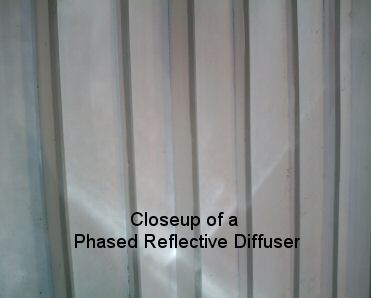 eate
a reflection to spread throughout the room while some rely on "phase
reflective diffusion" which means the object is to have many small
parallel reflective surfaces to create reflections of different timing to
reduce the hard apparent echo from the untreated surface. There has been
a new kind of diffuser in the last few decades called a "Reflective-Phase
Grading" diffuser which uses multiple reflective surfaces divided by thin
walls to create "wells" of varying depths. This creates small
resonant pockets of air that compress and scatter throughout the room as well
as having several small reflections instead of one large one. The most
effective versions of these diffusers are "Quadratic Residue Diffusers"
and "Primitive Root Diffusers". These are all based on the same
basic principles but the math behind determining the depths of the wells is
different. It should be noted that Auralex seems to prefers the
"Golden Ratio" for making diffusers. The Greek's theoretical
ideal room ratio of 2.62:1.62:1 is applied to the depth of the surface of the
diffuser in addition to some other types of surface variations. While
this is not known to be the best, it is inexpensive to
eate
a reflection to spread throughout the room while some rely on "phase
reflective diffusion" which means the object is to have many small
parallel reflective surfaces to create reflections of different timing to
reduce the hard apparent echo from the untreated surface. There has been
a new kind of diffuser in the last few decades called a "Reflective-Phase
Grading" diffuser which uses multiple reflective surfaces divided by thin
walls to create "wells" of varying depths. This creates small
resonant pockets of air that compress and scatter throughout the room as well
as having several small reflections instead of one large one. The most
effective versions of these diffusers are "Quadratic Residue Diffusers"
and "Primitive Root Diffusers". These are all based on the same
basic principles but the math behind determining the depths of the wells is
different. It should be noted that Auralex seems to prefers the
"Golden Ratio" for making diffusers. The Greek's theoretical
ideal room ratio of 2.62:1.62:1 is applied to the depth of the surface of the
diffuser in addition to some other types of surface variations. While
this is not known to be the best, it is inexpensive to 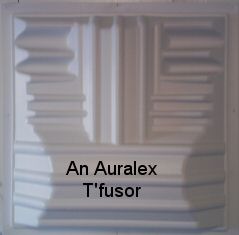 manufacture
and when treated further to increase density (they're made of thin hollow
plastic), can be very effective for a significantly lower cost than RPG
diffusers. Another factor is that most RPG type diffusers only scatter
sound in 2 dimensions while Golden Ratio diffusers such as the Auralex T'fusor
scatters in all 3 dimensions. It should be noted that PRDs can also come
as a simple RPG style without dividing walls to create a less expensive 3D
diffuser called a "Skyline
Diffuser" though is still quite costly at several hundred dollars USD
for 4 square feet. There is also something called a "Binary
Diffuser" which is essentially a flat board with holes in it to allow
some wavelengths to pass through it while reflecting others. The surface
behind the diffuser then reflects the sound. This is a cost effective low
profile way to diffuse sound but is not nearly as effective as the QRD.
manufacture
and when treated further to increase density (they're made of thin hollow
plastic), can be very effective for a significantly lower cost than RPG
diffusers. Another factor is that most RPG type diffusers only scatter
sound in 2 dimensions while Golden Ratio diffusers such as the Auralex T'fusor
scatters in all 3 dimensions. It should be noted that PRDs can also come
as a simple RPG style without dividing walls to create a less expensive 3D
diffuser called a "Skyline
Diffuser" though is still quite costly at several hundred dollars USD
for 4 square feet. There is also something called a "Binary
Diffuser" which is essentially a flat board with holes in it to allow
some wavelengths to pass through it while reflecting others. The surface
behind the diffuser then reflects the sound. This is a cost effective low
profile way to diffuse sound but is not nearly as effective as the QRD.
When treating a room, some people try to simply "kill" all reflections using absorption in a given space. This does not work as it is impossible to completely kill all reflections especially in the lower frequencies. Even if it were possible to remove all reflections, it would leave a very unnatural sounding room which would create sonic results that would not translate well to a real world environment. Pure diffusion without absorption can also create many problems as simply scattering sound can lead to a cluttered environment where clarity of sound is impossible to achieve. Most studio control rooms are based on the LEDE method of controlling sound. LEDE means "Live End, Dead End". The room from the front wall where the monitors are up to the point of the listen position has primarily absorption while from the listening position to the back of the room is left live and usually incorporates diffusion. A pure LEDE environment is incredibly dangerous as it doesn't exist in the real world and again it is almost impossible to absorb far enough into the low frequencies. Instead, broad band absorbers are put in all corners to reduce bass resonance in the room while spot treatments are placed on the ceiling and on the walls between the monitors and listening position as well as on the wall directly behind the monitors. This creates a "Reflection Free Zone" of sorts where the listening position is intended to be relatively low in early reflections. Early reflections are the first reflections to be heard by the listener before the reverberant field forms (usually within 20ms-40ms). Diffusion is used to prevent any hard echoes from reaching the listener and hopefully create more of a reverberant field than a flutter echo. It has been said, though, that if the boundary in question is within 10' of the listener (be it human or microphone) then absorption should be used instead of diffusion as diffusers need space to scatter the sound sufficiently. In a recording situation there is no dedicated listening position so an even spread of diffusion and absorption with gaps in between treatments is ideal. Spot treatment is also a great idea if there are designated areas for certain applications such as putting absorption on the wall behind the drum area and on the ceiling over it.
In the natural world without walls or ceilings, the "First Significant Reflection" will always come from the ground. The FSR is the first reflection within 6dB of the loudest reelection in an ambient field. The reason this is important is humans subconsciously use the FSR to determine distance from an object. When an object is very close, such as a person speaking to a listener from 2' away, the initial sound will take about 2ms to reach the listener while the FSR will be about 11ms, which is perceived as 9ms by the listener once the initial time delay between production of sound and hearing of sound is subtracted. If the speaker is 10' away, the FSR will be about 5ms. So the further away the listener is, the shorter the "Initial Signal Delay" gap, or the time difference between the direct sound and the FSR is. If one is in a situation where the FSR is very short, it obscures detail due to phase shifts, that is 2 identical sounds arriving at one point at different times interfere with each other creating what's called a comb filter effect where some frequencies are reinforced while others are cancelled. In addition to comb filtering, the subconscious assumption is that the sound seems distant even if it's less than a meter away. This applies to both recording and listening situations. So in an ideal situation, the FSR will be greater than 15ms or 20ms would be even better. These time delays between direct sound and reflected sound can be calculated using Pythagorean Theorem. But a great trick is to have a friend move around the room area between the monitors and the listening position with a mirror. For instance, if they place the mirror on your desk and you can see the monitors in the mirror from the listening position, this will be a significant reflection and should be treated. Any place between the listening position and the monitors where the speakers in the monitors can be seen in the mirror should be treated especially the ceiling. Of course one cannot put acoustic tile on their mixing board so instead, the monitors and board position should be adjusted so that the reflection from the board should stay below neck level. The object is to redirect the reflection in a in a direction that will not allow it to be heard. Don't neglect the fact that a reflection from the ceiling will also reflect off of the board making the ceiling that much more important to treat. The LEDE idea originally came from the notion that the listening position should be completely devoid of early reflections so that the early reflections coming through the mics in the recording room can be heard. However, no normal room is devoid of early reflections so a better idea is to extend the ISD gap for the FSR to 5ms. In addition, reducing the amplitude of early reflections to be more than 10dB-15dB below the direct sound is a good compromise over the LEDE technique. In recording, treatment should be used between microphones and the sound source. In the case of a small amplifier where the speaker center is 1' off the ground and the microphone is 3" from the speaker at the same height, the ISD will be 2.03ms. So either very heavy absorption needs to be placed there or the amplifier and mic need to be raised off the ground to avoid phase shifts. In recording, it is desirable to have the ISD gap to be greater than 5ms for maximum clarity. Please note that the listening position should cover a range of motion. In a small mixing room, it will be difficult to get a decent ISD gap because object in the room must be so close together. However, since a small room will likely have fewer listeners in it, an RFZ of 4 square feet may be satisfactory while a large mix room should go for an RFZ of more like 25 square feet or more to hold more people.
Resonance can be a huge and often overlooked problem. Even if great care is taken to avoid all kinds of modes, the various materials and even the room itself can vibrate on their own. The classic clich of an opera singer shattering a glass with their voice is no joke but rather a reality. Everything resonates to one well or another. Resonance is the frequency at which a specific object vibrates when struck. It goes beyond that though, if a certain object resonates at 1KHz and something else is producing that frequency nearby, the first object will actually vibrate in coincidence with the sound and even amplify it. If the source sound is loud enough and close enough to the resonant frequency of another object, it can actually destroy itself. Never-the-less, an object subject to resonance can cause sonic artifacts similar to standing waves in a room. Acoustic instruments rely on resonance to amplify the low volume sound of their actual sound sources such as the body of an acoustic guitar amplifies the sound of the strings. Drywall, while not a very good soundboard can resonate as well. Putting sound damping material on these types of objects should do well to reduce resonance. It can be a big problem for monitors to transmit vibration down through the objects on which they sit causing it to resonate as well. Isolation is the answer in this case. If the monitors are on a large surface, they should be moved and placed on speaker stands which are not as apt for resonance or hang them from the ceiling. Even at that, many people find it necessary to have sound absorbing material on the stands between the platforms and the monitors. It's generally a good idea to put instrument amplifiers on sound damping material as well as the floor can add to resonant problems. This is good general practice even if the floors are not apt to resonate as it can add a little extra height to reduce phase problems from sound reflecting off the floor. As previously stated, the room itself can resonate. In larger rooms this usually isn't a problem but all rooms have specific volume and the air inside that room is elastic in nature making it ideal for resonance. A cavity that contains a specific volume of air intended to vibrate is called a Helmholtz resonator. A good example of a Helmholtz resonator is an ocarina or blowing across the mouth of a bottle. The air gets compressed inside the object and when it reaches a critical pressure, expands again even if the air is still getting some compression. Since it's still under compression, the air gets compressed again when the pressure is relieved from the cavity containing the air. A room can act as a Helmholtz resonator but strangely, such resonator covered with a thin membrane can be added to a room with a resonance problem to actually REDUCE resonance in such a room by displacing the problem frequency into the resonant cavity. Though it's almost impossible to completely get rid of resonance, just like reflections, this problems can be tamed by treatment. Materials good for reducing resonance are generally very dense and extremely flexible such as rubber or once again, compressed fiberglass.
Transmission is a great issue for isolation purposes. Though beyond the scope of this article, a lot of money goes into reducing transmission of sound through walls in studio situations. All objects transmit sound but some are better at it than others. Isolation booths are often placed on small pieces of rubber which does not transmit sound very well. Rubber is also often placed between wall surfaces such as gypsum board and their supporting studs to reduce transmission through the studs themselves. Minimal numbers of screws or nails are used as they transmit high frequencies very well. Air is a great insulator so by using as few studs as possible and using very broad studs such as 2x6 instead of the usual 2x4, isolating one room from another is much easier. In fact many recording rooms are actually smaller rooms placed inside larger rooms where the larger room is generally a large rectangular prism shape while the room inside it is suspended (usually at an angle to the surrounding room to reduce standing waves and resonance between walls) with cables or placed on thick rubber feet similar to isolation booths. Fiberglass is a good insulator and can reduce resonance when used properly. In general, thermal insulation material is also good sound insulation and electrical insulation. Some materials are simply more prone to transmit energy in general than others. An exception to this is the expanding foam that many people use for insulation of houses. The reason is, even though it's a highly porous material, it dries hard and is thus subject to resonance itself at a multitude of frequencies. Hard objects generally transmit energy better than soft objects. Soft, dense objects tend to absorb vibrations because they can compress and stretch with air while density adds to their ability to "catch" vibrations instead of simply letting the vibrations pass through them.
Refraction is yet another phenomenon of acoustics. Though it's not normally a problem, sound can be bent with changes of density in air just like changes of density can bend light like through a lens. Sound does not always travel at the same speed. Things like humidity, air pressure and temperature greatly effect the speed of sound and when high humidity meets low humidity, cold air meets hot etc, the direction of sound gets skewed. A room with a cold floor and a hot ceiling will cause sound to bend as it travels through the room. While this can be a very large issue outdoors, it's not normally a problem in studios. In the morning when the ground is getting hot but the air is still fairly cool, sound tends to bend upward. The PA system at the famous race car track in Indianapolis actually has the speakers pointed below the audience because most races are in the morning. Thousands of dollars are saved by relying on this fact. In the evening, it's best to have the speakers set fairly high or pointed slightly over the audiences head so the cooling ground with warm surrounding air will cause the sound to bend downward into the audience. One of the famous sermons from Jesus was made at the BOTTOM of a hill while the audience was on higher ground instead of the expected other way. Jesus was addressing a very large audience that would otherwise be unable to hear him speak if he had been on high ground or if it were evening but since this was in the morning, the audience was in the optimal position to hear him speak.
While this may seem like a complex and somewhat exhaustive essay on the basics of acoustics, learning acoustics takes a lifetime and even at that, many properties of sound are yet to be discovered. So there will be some errors in the aforementioned information as well as a lot of information missing. As always, one is welcome to E-mail the author to make suggestions for improvement. In the mean time, some helpful hints.
- Bass tends to collect in corners, especially acute angles (less than 90 degrees on the inside of the angle). Keep listeners, microphones and sound producing objects out of corners. A common trick is to draw a picture of the room and use a digital pain program like MS Paint to draw an oval inside the drawing. The oval should barely touch the walls of the room drawing. Any area that falls outside of the oval should not be used for audio purposes. Below is a possible arrangement for a set of monitors, mixing desk and chair for the operator. Notice how everything falls inside the oval and that the listening position is slightly forward from the half way point to avoid redundant reflections from front and back wall.

- Keep sound sources and sound pickup devices away from boundaries such as walls. Monitors should be meter away from the nearest wall to avoid phase shifts and exaggerated bass. Remember almost all sound sources radiate low frequencies equally in all directions so object behind speakers will reflect low frequencies.
- Try to stay away from any kind of redundant or evenly devisable factors in any kind of measurements. 20x10 is not a good ratio for a room as 20 is evenly devisable by 10. If your monitors are meter from the front wall, don't let them be meter from the side walls, .66 meters is better. When in doubt, stick to prime numbers. So the bass amp can be 5 meters from one wall and 7 meters from another which will place it 3 meters from the ceiling. Prime numbers are almost always safe.
- Avoid small rooms with parallel walls. If building an isolation booth, 5 or more walls is desirable to avoid acute angles. Avoid redundant or near-redundant dimensions.
- Overall, size is often more important than shape. A room that's 8m x 6m x 3m is most likely better than a room that's 6m x 5m x 2m even though the ratio of the second room is better. Though some ratios are fairly universally better such as the Golden Ratio of 2.62:1.62:1
- Bass is the most difficult to control as far as sound goes. Treatment to reduce bass problems should be addressed first and high frequencies are usually sufficiently tamed simply as a byproduct.
- Packing foam and normal fabric may seem to be adequate at reducing high frequencies but are no where near dense enough to control low frequencies. Using these types of materials for sound absorption will cause more problems than they solve because human perception is more tuned to high frequencies. They will will make for a dead sounding room but low frequency problems will be disproportionately exaggerated.
- Placing the monitors in the room and calibrating them is more important than WHAT type of monitors are used. Most professional monitors are accurate to 3dB from 50Hz-18KHz while poor placement and poor room treatment can cause the sound to be skewed as much as 40dB. So spending $1,200 on monitors is a waste, you'd be better spending $500 on monitors and spending another $500 on room treatment and proper speaker stands. In many cases, $500 monitors simply placed well will be better than a $1,200 set of monitors in the corners of the same room as or on top of a mixing desk.
- Using an EQ to "tune" a room will not work because it is not fine enough to tackle standing waves nor will it take into account different problems at different places in the room. Furthermore, even if you manage to use a 24,000 band FFT EQ to cut problem frequencies in the room, the accuracy of the direct sound from the monitors will be severely compromised. People are far more sensitive to the quality of the direct sound than the reflected sound of the room.
- Monitors should be placed at head level with your ears falling BETWEEN the level of the tweeters and woofers. It's generally best to have the tweeter set above the woofer rather than to the side. This is to avoid compromising phase shift and skewed stereo imaging
- Monitors should be behind the mixing desk and not on top of it to avoid both resonance and phase problems of the hard reflective surface.
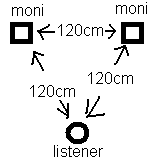
- Monitors should form an equilateral triangle with the listener as in the illustration.
- Ceilings don't normally exist in the natural world, try to either utilize a room with a high ceiling or make the ceiling sound as if it's not really there with broadband absorption. Ceilings harm more drum and vocal recordings in home studios than anything else aside from poor mic placement.
Floors are often an issue. Most higher end studios have tile, wood or cement floors each having their own unique sound. What you want to avoid is carpet because it absorbs high frequencies much better than low frequencies. This isn't as much of an issue in control/mix rooms as it is recording rooms where microphones are often close to the floor.
Vaulted ceilings or any concave surfaces tend to focus sound with great intensity. If you can’t avoid these, treat them heavily with diffusion or better yet, absorption.
- There's no substitute for moving air. Simply plugging an instrument into a mixing board will sound unnatural regardless of how it is processed.
Additional reading
http://www.ethanwiner.com/acoustics.html for info on rigid fiberglass
http://www.saecollege.de/reference_material/pages/Coefficient%20Chart.htm for many other absorption coefficients.
http://en.wikipedia.org/wiki/Acoustics for general acoustics information.
To E-mail, just type what you see in the image below into another window. Sorry for the inconvenience but it prevents Spam bots.
